44% of Macy’s total sales are now from e-commerce. Mall owners, even the largest ones, are handing malls back to their lenders.
By Wolf Richter for WOLF STREET.
Macy’s, when it reported its earnings this morning, confirmed its own physical merger, and it showed the benefits of Macy’s decision years ago to take e-commerce seriously, knowing that its physical stores – despite what it said publicly – were on a slow exit path, evidenced by its countless store closures. The pandemic accelerated this trend with a leap forward. But it’s complicated and difficult, and Macy’s is losing ground in the growth of its digital sales.
In the fourth quarter, ending January 31, Macy’s online sales rose 21% year-over-year, reaching $3.0 billion, accounting for 44% of its total net sales. E-commerce sales are those made online, regardless of how the merchandise entered the home, whether by delivery or in-store pickup.
But its physical sales in the fourth quarter collapsed by 35% to $3.8 billion, representing only 56% of Macy’s total sales. At this rate, physical sales will be less than half of Macy’s total sales by the end of the year. The downward spiral has now reached critical mass.
Total sales in the fourth quarter fell 19% year-over-year to $6.8 billion, with the increase in online sales unable to offset the decline in physical sales.
The fact that Macy’s online sales already accounted for 44% of its total sales, a huge achievement, shows two things:
- Years spent massively investing in e-commerce, including building its order processing infrastructure, rather than relying on a miraculous revival of its physical stores.
- The decline in sales in its physical stores, which has increased the share of e-commerce sales in total sales.
But Macy’s 21% digital sales growth is relatively weak in the e-commerce pandemic era.
Walmart – it became too late the e-commerce religion and inexplicably gave Amazon two decades of head start, but in recent years has become dead serious about it – reported that Walmart’s e-commerce sales in the U.S. in the fourth quarter soared by 69% and Sam’s Club sales jumped by 42%.
Bed Bath & Beyond indicated that in the quarter ending November 28, its e-commerce sales surged by 75% year-over-year, accounting for about one-third of its total sales, while sales from its physical stores fell and overall sales dropped by 17%.
Best Buy, which benefited from purchases of work-from-home and home-learning equipment, has not yet reported the fourth quarter. But in the third quarter, it indicated that online sales soared by 174% year-over-year to $3.8 billion, nearly tripling from $1.4 billion the previous year, and representing 35% of its total sales.
Target has not yet reported the fourth quarter either, but in the third quarter, its e-commerce sales skyrocketed by 155%.
The Commerce Department reported last Friday that e-commerce sales in the U.S. — sales from pure e-commerce players as well as sales made through the e-commerce channels of physical retailers, such as Macy’s — surged by 32% in the fourth quarter compared to the previous year, reaching $245 billion, not seasonally adjusted, representing 15.7% of total retail sales:
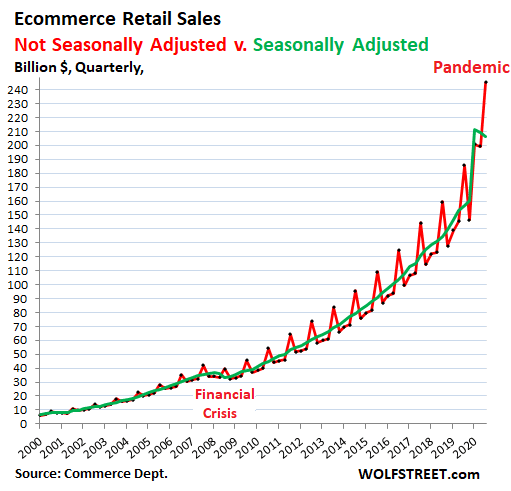
In dollar terms, the last three quarters – the pandemic quarters – show the accelerated transition to e-commerce with gigantic year-over-year jumps of the order of $55 billion to $61 billion, including $60 billion in the fourth quarter:

But total retail sales include the notoriously resilient online sales of new and used vehicle dealers, grocery stores, and beverage stores, and of course, gas stations. Together, they represent more than half of total retail sales. The remaining physical stores, which account for less than half of retail sales, have therefore been the most affected by the shift to e-commerce.
This is very painfully the case for department stores, once an iconic American institution. This is the 20-year progression of the disappearance of department stores that accelerated in 2020 and will close to completion:

Some pandemic e-commerce winners.
The Commerce Department began publishing “experimental” data last year on certain categories of online sales, since 2019. This data is illustrative: it shows how some sales categories, including those that have long been considered very resistant to e-commerce, have moved online.
Online sales of groceries and beverage stores have nearly quadrupled since the first quarter of 2019, reaching $7.3 billion, after years of trying unsuccessfully, including efforts by Safeway, Amazon, and Google, to get Americans to buy groceries online:

Online sales of automotive dealers and auto parts have increased by 42% since the first quarter of 2019, reaching $13 billion, with a focus on used vehicles, notably from several online-only used vehicle retailers, such as Vroom and Carvana:

Sales of clothing and accessories in e-commerce have more than doubled since the first quarter of 2019, reaching $10 billion:

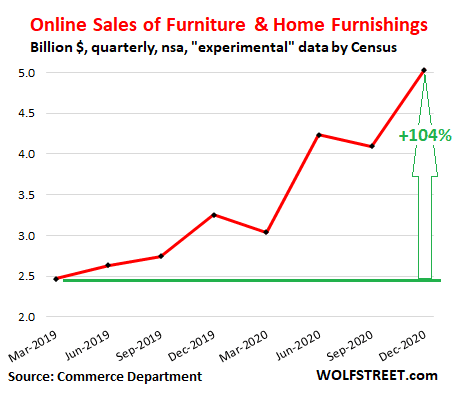
Sales of furniture and home furnishings in e-commerce have also more than doubled since the first quarter of 2019, reaching $5 billion:

The most significant impact of this transition to e-commerce concerns commercial real estate, in two respects: industrial properties, such as warehouses, distribution centers, and delivery hubs, have become a hot segment. But retail, especially malls with department stores as anchor points, is sinking into the mire, with mall owners defaulting on their mortgages and letting malls return to lenders.
This includes the largest mall owner in the U.S., Simon Property Group, which is becoming a prolific jingle-mailer to throw its malls away. CMBS holders are eating the losses. Read… The largest U.S. mall owner Simon Property Group has sent Jingle Mail to Deutsche Bank which Eviction on the mall, but received no bid
Tag: More info on CBD