
The symbol ∞ appears on calculators, in equations, sometimes tattooed on a wrist. But who first drew it, and why this precise shape? Understanding the meaning of the infinity symbol requires going back to the 17th century, when mathematicians were looking for a simple way to denote what has no end.
The lemniscate, a geometric curve before being a symbol
Before talking about infinity, let’s talk about geometry. The figure of the lying eight has a technical name: lemniscate. This word comes from the Latin lemniscatus, which means “ornamented with ribbons.” The curve was formally studied by the mathematician Jacques Bernoulli at the end of the 17th century.
Specifically, a lemniscate is a plane curve where each point satisfies a specific property: the product of the distances from this point to two fixed foci remains constant. You can visualize this as two circles intersecting at their center, forming this continuous loop with no beginning or end.
What makes this curve remarkable is its perfect symmetry. It folds back on itself around a central point, creating two identical loops. This geometric property likely inspired its adoption as a visual representation of infinity, long before Bernoulli formalized it. To learn more, discover the meaning of the infinity symbol and its detailed origins.
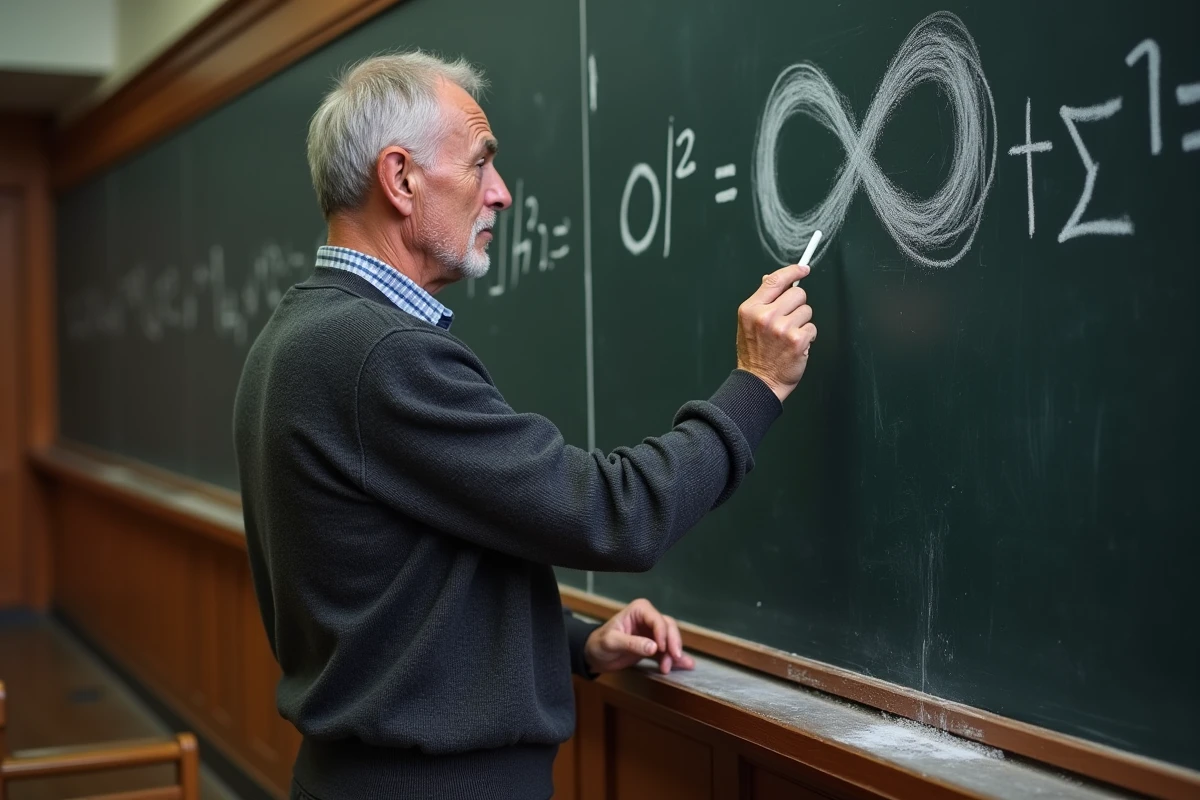
John Wallis and the invention of the infinity sign
The British mathematician John Wallis (1616-1703) was the first to use the symbol ∞ to denote infinity. Wallis left no written explanation for the choice of this precise shape, and the exact origin of the drawing remains controversial.
Why this symbol replaced words
Before Wallis, mathematicians wrote the word “infinity” in full in their proofs. This habit slowed down work and created ambiguities. Two scholars could use the same word for different concepts: a number greater than all others, or a quantity that grows without ever stopping.
The sign ∞ resolved this problem. A unique symbol allowed for the separation of mathematical infinity from philosophical debates. Theologians spoke of a divine infinity, philosophers of a conceptual infinity. Mathematicians now had a neutral notation tool, detached from these interpretations.
Potential infinity and actual infinity: two meanings for one sign
Have you ever counted 1, 2, 3, 4… knowing that the sequence never stops? This is potential infinity. It describes a process that can always continue, without reaching a final point. Aristotle defended this view: infinity does not exist as an object; it exists as perpetual motion.
Actual infinity, on the other hand, treats infinity as a real quantity. It was Georg Cantor, in the 19th century, who provided a rigorous framework for this idea. He showed that some infinities are larger than others. The set of integers is infinite, but the set of real numbers is “more” infinite.
This distinction profoundly changes the significance of the symbol ∞. In a mathematical limit, it represents a process (potential infinity). In Cantor’s set theory, it denotes sizes of sets (actual infinity). The same sign, two uses.

Zeno’s paradoxes: when infinity challenges intuition
The Greek philosopher Zeno of Elea formulated paradoxes that remain among the best illustrations of the problem of infinity. The most famous: Achilles and the tortoise.
Achilles runs faster than the tortoise, but the tortoise has a head start. When Achilles reaches the tortoise’s starting point, it has moved ahead. When he reaches this new point, it has moved ahead again. The sequence of catch-ups is infinite. Therefore, Achilles should never surpass it.
This paradox has troubled thinkers for centuries. The solution came from modern mathematics, with the notion of a convergent series:
- Each catch-up interval is smaller than the previous one, forming a decreasing sequence
- The sum of these intervals, although infinite in the number of steps, converges to a finite value
- Achilles surpasses the tortoise at a specific moment, calculable by this sum
The symbol ∞ does not mean “impossible to reach”; it denotes a process whose sum can remain finite. It is this nuance that allowed for the birth of infinitesimal calculus.
The infinity symbol beyond pure mathematics
In physics, the sign ∞ appears in equations describing gravitational singularities, such as those of black holes. When a quantity approaches infinity in a model, it often signals that the model is reaching its limits, not that reality is infinite.
In theoretical computer science, the symbol is used to describe loops without stopping conditions or unbounded data sets. Recent work explores its use in notations related to quantum algorithms, to model potentially infinite superpositions.
Physics and computer science use the sign ∞ as a modeling tool, not as a statement about the nature of the world. Infinity remains an operational concept, not a measure of the real.
- In physics: it signals the limits of a mathematical model in the face of a singularity
- In computer science: it describes processes or sets without a defined upper bound
- In philosophy: it continues to nourish reflections on the limits of human knowledge
The journey of the symbol ∞, from Wallis’s pragmatic notation to contemporary physics equations, illustrates a constant: each era redefines infinity according to the tools it has. The lying eight curve remains the same, but what it contains has never ceased to grow.