
Every family eventually operates on autopilot: the same reminders in the morning, the same negotiations in the evening, the same micro-tensions around meals or screens. Reinventing family routine does not mean breaking everything to start over. It is more about identifying the moments that generate stress and introducing concrete, sometimes tiny, adjustments that change the rhythm of the day.
Family routine and mental load: the real problem to solve
Have you ever noticed that arguments almost always break out at the same times of the day? In the morning before school, after work, at bedtime. These peaks of tension are not related to the children’s personalities or a lack of patience from the parents. They signal an imbalance between organization and attention capacity of each household member.
The parental mental load focuses on invisible planning: anticipating meals, checking backpacks, managing medical appointments. When one person carries this planning alone, the routine becomes a source of exhaustion rather than a reassuring framework. As detailed by Blog Famille on family routine, breaking certain automatism allows for redistributing this load and finding pleasure in shared moments.
The first lever is to name the invisible tasks and make them visible to the entire household. A magnetic board on the refrigerator, a paper list on the front door: the medium matters less than making each person’s expected contribution concrete.
Co-organization boards: involving children in the daily rhythm
In recent years, visual co-organization tools have multiplied in Francophone families. Magnetic boards, illustrated routines with pictograms, shared wall planners: the idea is to make children active participants in their own routine.
This approach works because it relies on a simple principle. A child who chooses the order of their tasks carries them out with less resistance. When they co-create the board (choosing pictograms, the order of brushing teeth or getting dressed), they no longer need to be told the same instruction three times.
How to build an effective routine board
- Limit the number of tasks displayed to five or six per time slot (morning, afternoon, evening) to avoid visual overload, especially for those under seven years old.
- Allow the child to place the labels or magnets in the order they prefer, as long as the final result remains coherent (you don’t get dressed after going out).
- Include a “free time” or “surprise” box in the day, reminding that the routine is not a military schedule.
Feedback from Francophone communities shows a notable decrease in verbal reminders and morning disputes when this co-construction is genuinely shared. The board does not replace the parent, but it shifts the conflict: the child negotiates with the board, not with the adult.
Screens in the family: creating common rules rather than prohibitions
Screen management crystallizes a good portion of family tensions. Prohibiting doesn’t work for long. Letting it go doesn’t either. The most productive approach is to transform screen management into a shared family ritual.
Some families use a “screen box”: a bin or basket where each household member (including adults) places their phone or tablet during meals or the last hour before bedtime. The collective gesture changes the dynamic. The child does not feel punished since the parent does the same.
Setting a framework without rigidity
Wondering how to set limits without triggering a crisis? The key lies in one word: predictability. When the child knows in advance that they will have screen time after snack time and that this time has a clear end (a timer, an episode, a game), the transition goes more smoothly.
Displaying these rules on the same medium as the rest of the routine reinforces their legitimacy. They are no longer an arbitrary decision of the moment, but a household habit, co-decided during a family discussion.

Micro-rituals of reconnection: what really changes the atmosphere at home
Big family outings matter, but it is the repeated micro-moments that shape the daily climate. A reconnection ritual lasts between two and ten minutes. It requires neither budget nor preparation.
- The “best moment / worst moment” at dinner: each person at the table shares a good and a bad moment from their day. The exercise takes three minutes and gives parents a window into their children’s inner lives.
- A hug or a physical gesture upon returning home, before any questions about homework or behavior.
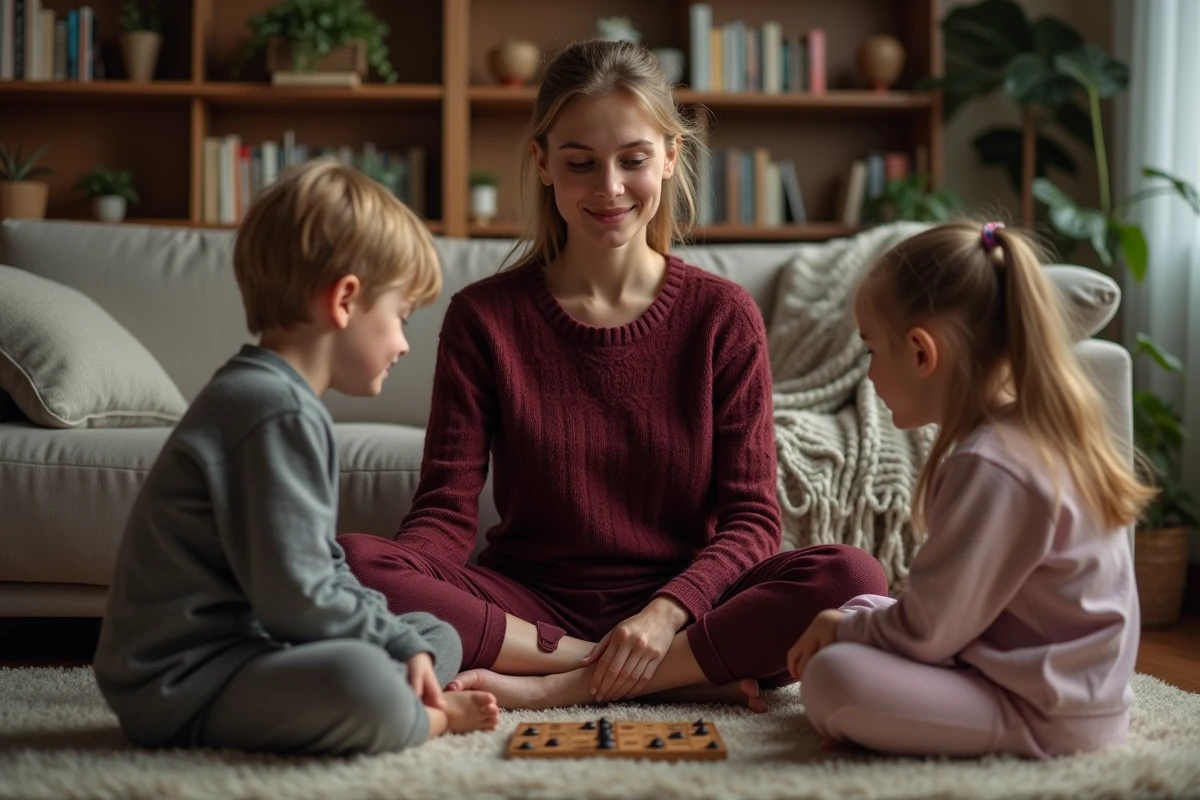
- Five minutes of free play with the child, without instructions, without educational objectives. The child chooses, the adult follows.
These short rituals create a positive emotional anchor around the transitions of the day. They replace moments of friction with moments of contact. In the evening, instead of starting with “Did you do your homework?”, we begin with an exchange that expects nothing.
Adapting rituals to the children’s age
A three-year-old needs concrete gestures and repetition. A teenager will prefer a shared moment around an activity (cooking, walking, music) rather than a verbalized ritual they will find infantilizing. The right ritual is one that each family member agrees to maintain without needing to be reminded.
Family harmony is not decreed during a solemn meeting on a Sunday evening. It is built through an accumulation of small tested adjustments, kept or abandoned according to what actually works for you. A modified board, a screen box placed on the entrance furniture, three minutes of sharing at dinner: these gestures may seem modest, but their repetition ultimately changes the rhythm and habits of the entire family.